Indie Quickies #6: Rail Guns for Everyone
A synesthetic score-attack shooter, an adorable incremental adventure, a beginner friendly nonogram puzzler, and more!

I'm not dead! I have, however, been busy with life things as well as my writing for Invisible Oranges, which has really picked up over the last few months. As a result, I've let the ol' Chantastic Voyage languish, but no more! Just in time for the Steam Summer Sale (and probably a few other sales on various platforms, I bring you a mega-ultra-deluxe edition of Indie Quickies that covers some of the heavy hitters that I've been playing.
Sektori

For a few weeks, Sektori consumed my life. It is a (literally) heart-pounding twin-joystick shooter in the vein of Geometry Wars that literally kept me up at night, and whether or not I was actively playing it past midnight, the dancing, colorful shapes paraded across my closed eyelids.
Sektori is the brainchild of Kimmo Lahtinen, whose previous work with Housemarque more than adequately prepared him for this sort of arcade score-attack fever dream. The game is also a spiritual sequel to one of his first solo games, a humble little shmup called Trigonarium. While that game was a rough draft or proof-of-concept, Sektori is a full-fledged masterpiece of addictive game design.
The basic mechanics - beyond just shooting enemies - are actually fairly complex. In addition to your typical blasters and missiles, there's also an explosive recharging dash, called a strike. Gathering XP shards dropped by destroyed enemies will spawn upgrade and point tokens around the level. These can be picked up by simply flying over them, but to encourage a more aggressive playstyle, Sektori encourages players to strike into these tokens, which will immediately refund the strike (making it free) and build up a point multiplier. All of this must be juggled while actively trying not to die, which means that while Sektori feels amazing to play, it is not a particularly relaxing experience.

The campaign mode is the main attraction. It's an arcade-style shoot-em-up (henceforth abbreviated as "shmup") with armies of geometric enemies, fiendishly difficult bosses, and dizzying bullet and laser patterns that will soon become seared into your retinas. Bosses are presented in a random order each run, and each boss' difficulty scales with how far it is encountered in each run. I've played the game for roughly 15 hours and still have not beaten the campaign on the Experience (read: easy) difficulty, but I am strangely unbothered by my failure - that's how satisfying Sektori's gameplay is.
While each of six "side" modes may initially appear like training simulators for individual skills and mechanics, they are all fun in their own ways. There's a pair of old-school modes inspired by Geometry Wars: Classic, which is your standard score-attack level, and Gates, in which weapons and strikes are disabled, and damage can only be dealt by flying through exploding portals. There's a boss rush that lets you practice the climactic fights and all of their permutations (of which there are many). My favorite of the bunch is called Crash. Damage can only be dealt with a supercharged triple-strike, but the game randomly spawns tokens that will refill your strike meter. The result is a mad dash around the level in which you must maximize each of your three dashes in order to get to the next powerup token, which, if struck, will explode and give a hefty point bonus. Who said that single-mechanic modes can't be fun?

My only gripe with Sektori is that the visual clutter can become overwhelming. How long did it take you to find the player ship in the screenshots above? Well, it only gets harder when everything is in motion. There are times when I legitimately don't know what hit me. This isn't to say that there's anything wrong with the game's hitboxes - it's more of an issue with enemy visibility. Nonetheless, Sektori is a worthy successor to the classic Geometry Wars games, and I hope that its success inspires other devs to give this genre of shmup a shot.
Squeakross - Home Squeak Home

Ignoring the atrocious puns in the title, this is a great nonogram/Picross game that also manages to be fairly beginner friendly (if you're not sure what a nonogram is, check out this write-up I did a few years ago). Now, I'd like to consider myself an intermediate nonogrammer. I'm still intimidated by 20x20s and beyond, but I can hold my own on a 15x15 puzzle. Squeakross shakes things up by introducing 15x15s fairly early alongside some odd shapes that are longer in one dimension than the other. Most nonograms are squares and have axes in multiples of fives, but Squeakross has no problem throwing 8x12s at you within a few pages of its in-game puzzle catalog.

Thankfully, there are a variety of quality-of-life features that make these nonograms approachable for all ability levels. First--and most importantly--there's no penalty for wrong moves like in most official Jupiter-made Picross titles. There are no points, and I'm pretty sure that there are no tangible rewards for completing puzzles within a certain time limit. Squeakross also adds the ability to mark squares as "maybes" to revisit, which is very helpful on particularly gnarly puzzles.
Now to discuss the elephant in the room: why "squeak"-cross? Well, your main character is a mouse, and each puzzle that you solve gives them a new piece of furniture to place in their house. You also unlock clothes and accessories for your mouse as well as stickers. I honestly did not interact with this side of the game all that much, but I imagine that some folks will love this progression system, as it gives the player a reason to continue unlocking more pages or even prioritize certain puzzles over others to obtain particular pieces of furniture. Plus, every nonogram has a harder version that grants the the abilities to recolor and place multiple copies of that item in your mouse's home.

Squeakross may very well be the most accessible nonogram game on Steam, so I highly recommend it to anyone interested in this style of puzzle. Veterans may find it a bit too easy, but there's always Logiart Grimoire for the real Picross sickos out there.
Shelldiver

I bought this one in a bundle with Astro Prospector, and while that one was fun in its own right, I think that Shelldiver is the better game overall. Both are "incremental" games, a tag which, for the longest time, seemed to be synonymous with idlers and clickers. I have to credit Cauldron, which was featured in the last installment of this column, with introducing me to a slightly more active style of incremental game, which is why I decided to give Shelldiver a try. And boy, does Shelldiver make the numbers go up.
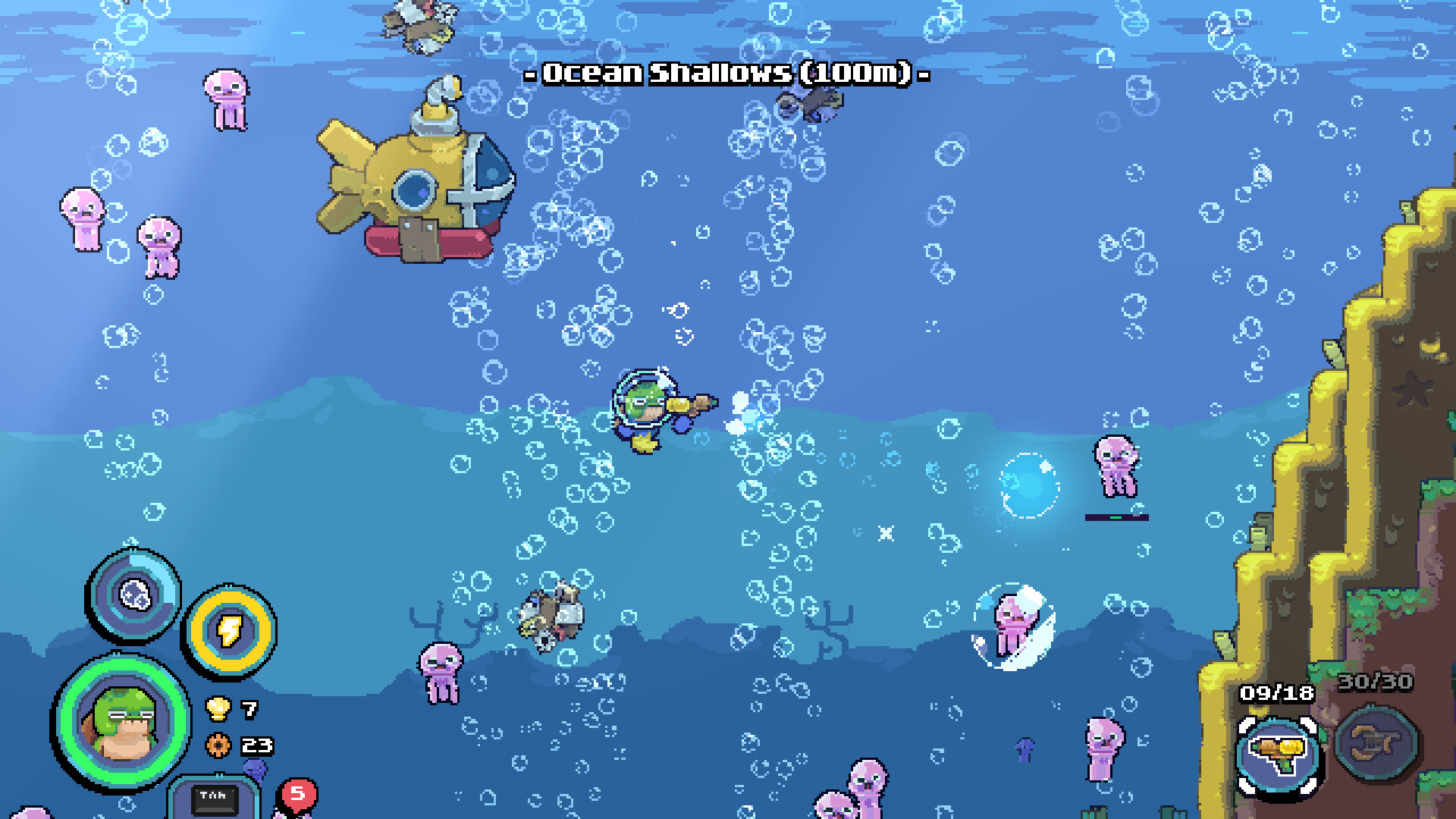
So what do you actually do in Shelldiver? Well, you (and your shell) dive into the ocean to harvest resources, which you then spend to enhance your equipment and build new installations on your island. Jellyfish are captured with a trusty bubble gun, while chunks of scrap metal and coral are broken down with a plasma cutter. As mentioned above, Shelldiver takes about half an hour to sink its teeth into you, with the first trickle of upgrades focusing on simple quality of life features like damage, range, and oxygen capacity. You eventually get to the more creative and zany additions like starfish turrets and chain lightning. Not only do the numbers go up; the rate at which you can rip through even the late game ecosystems becomes pretty frightening. The game is, by its very nature, a grind, but it's impressive to see how much the devs allow you to upgrade along the way--even if some of those mechanics are intended to make the first few dives feel like a slog.
The only real danger to your little turtle is the oxygen running out, but that will only result in you dropping most of the resources that you're carrying. There is no significant penalty to "dying". While I definitely wish that Shelldiver had a few more bells and whistles, the game nonetheless feels extremely focused on its core gameplay loop and nothing more. There's no story or additional minigames, which does make the game feel rather sparse, but those were the things that eventually torpedoed my enjoyment of Dave the Diver, a game that didn't know when to stop adding mechanics and taking agency away from the player. Shelldiver might be on the other extreme end of the spectrum, but its single mechanic remains satisfying for its entire 4-5 hour playtime. Ultimately, the game is a fun, bite-sized, mostly mindless experience that is still well worth your $4 or $5.
TerraTech Legion

I never played the original TerraTech, which was a novel mashup of multiplayer survival crafting and Besiege or Banjo Kazooie: Nuts & Bolts style vehicle building. However, I heard about this survivor-like/bullet-heaven spin off game last week and had to check it out.

TerraTech Legion is quite different than most games in its genre (e.g. Vampire Survivors, Megabonk, etc.) in that it is a mission-based game that gates its endless mode behind unlocks. This isn't necessarily a bad thing, but I will say that the main missions all follow the same general structure: spawn in on a planet with a fairly unremarkable vehicle and systematically destroy thousands of robots and the occasional building, augmenting your little car with ridiculous weaponry. The twist, as hinted in the first paragraph, is that all of the weapons must be manually attached to your vehicle in a level-up menu screen. Enemies also drop additional blocks that can help turn an unassuming buggy into a hilarious yet terrifying cluster of buzzsaws, railguns, drone launchers, and more.

Placement matters, as each weapon has its own particular firing pattern and range. Mounting all weapons facing forward is a death sentence--after all, even the more tanky vehicles don't excel when directly facing off with the enemy. Side-facing guns, like those on a gunship, are great fun, as they allow the player to drive in circles around enemies and maintain a steady rate of fire. Turrets can automatically target and attack enemies in any direction, but mounting more than one means that each new turret will slightly reduce the field of view of the ones that preceded it. This isn't that much of a problem, but it adds an additional later of strategy.
 |
| Look on my works, ye mighty, and despair |
As an added bonus, the game runs pretty well on my original LCD Steam Deck. It even has a specific graphics preset for Valve's (now very expensive) handheld PC, which was able to run the game at 60fps for a little under 2 hours.
Utopia Must Fall

When I first saw Utopia Must Fall pop up on my carousel of suggestions, I didn't know what the hell I was looking at. It appeared to be a bizarre mashup of Missile Command, Space Invaders, and Asteroids, but until I downloaded the demo to try it for myself, I didn't actually know how this game was supposed to play.
The main concept is simple: in each run, you protect a city from waves of alien invaders. The mouse aims your primary gun, which can be modified to function like a shotgun, an electrical coil weapon, artillery, and more, while the mouse buttons fire a nuke that has its own potential upgrade tree. Along the way, you choose various subsystems and perks that dramatically change the course of a run. Perhaps you'll want to invest heavily in drones. You could also halve the potency of your nukes but double your stockpile and production. There are a lot of options at players' disposal, and the arsenal will only grow as more upgrades are unlocked for future runs.

What's more, Utopia Must Fall has impeccable presentation. The graphics can be tweaked to resemble any number of classic CRT displays, the animations are slick yet slightly fuzzy, and the sound--oh man, the sound design in this game. Play this with headphones, and between the orchestrated chaos that you unleash upon your alien foes, the moody ambient electronic soundtrack (also available for $5), and the muted blips and blops of the UI, you're in for a real treat. Oh, and I'd be remiss if I neglected to mention Utopia Must Fall's dry sense of humor, which briefly appears in flavor text throughout the tech tree and various menus:

I'm not very good at this game, but it's still great fun to blast aliens with a rapid fire gauss gun as your drones and laser watchtowers pick off stragglers. This is a great one to play for a few runs before bed.
Tainted Grail: The Fall of Avalon

In the simplest terms possible, Tainted Grail: The Fall of Avalon is an open-world RPG is essentially a Polish studio's Arthurian take on the Elder Scrolls series, but that's now how the franchise got its start. The Tainted Grail multimedia universe actually began as a board game in 2018 before expanding into a tabletop RPG, a roguelike deckbuilder, and now an open world RPG.
As with the series that inspired it, Tainted Grail's main story drives game progression but is relatively unobtrusive until the player actively makes a choice to proceed; the real joy is to be found in the reasonably well-written side-quests, which take players through bandit hideouts, underwater temples, haunted castles, and more. Sure, most of these quests boil down to "talk to these people", "get these items", and/or "kill these entities", but hey, this is a video game after all. The fully voiced characters sound great, and their individual storylines often have interesting twists. In one quest, (minor spoilers ahead) I investigated some druidic ruins on behalf of a local doctor and amateur historian. I had just met this man because he was accused of being a quack by a toothache-afflicted villager. Before that storyline wrapped up, I was insulted by ghosts, attacked by bees, and confronted by a magical woodland spirit who wanted to murder her surrogate human father--all because some guy that I happened to encounter as part of a completely different quest was curious about nearby megaliths.
 |
| I also met whatever this is |
As with most fantasy RPGs, there is plenty of fighting, and Tainted Grail's combat is solid but fairly straightforward. Unlike in Oblivion or Skyrim, there is no directionality to weapons' swings - every melee weapon has a normal attack, a chargeable strong attack, and a dash/running attack - but The Fall of Avalon does have a zippy dodge and simple yet effective parry system that make the fights reasonably engaging. Though I haven't mained a magic character yet, I have invested some points into Spirit so that I can use summons to distract enemies, which has been great fun. I watched one of my hammer-wielding imps uppercut a bandit off a high wall, which remained hilarious even after realized that I would have to take a roundabout route to loot the ne'er-do-well's body.
The world of Avalon is broken up into distinct areas, one per act. You can't move on to the next major area until you have reached a certain point in the story, which might seem limiting at first, but it actually encouraged me to comb through that first area before moving on to the second. There is a ton of loot scattered throughout the various caves and camps, which makes exploration feel genuinely rewarding. I'm glad I spent the time to fully explore the first act, because there is a significant difficulty spike when transitioning to Act 2, to the point that some bandits and infected enemies feel strangely powerful. This came as a surprise when I was previously able to sprint up to basically any field mob in Act 1 and kill it in a single normal attack. Nights become far deadlier too, for reasons that I won't spoil here. I'll just say that I died more during my first few evening walks through Cuanacht than I did in the entirety of Act 1.

The most significant difference between Tainted Grail and The Elder Scrolls is the lack of a speechcraft/charisma system. The Practicality attribute is vaguely similar, governing a grab-bag of stats such as crafting and selling prices. There are some occasional speech checks that can change the course of certain quests (e.g. intimidating someone into cooperating because you have high Strength), but there isn't necessarily a robust conversation system. I personally didn't miss this feature, since I was here to fight my way through every encounter with a giant hammer. Serious RPers might take issue with this omission, though.
Finally, let's talk about performance. It's not great, especially considering the game's serviceable graphics. Nvidia users will probably have a better time thanks to built-in DLSS support, but us AMD users will have to settle for Unity's STP upscaling. It's better than nothing, though the bigger issue is that despite fairly modern PC specs and STP turned on, the game can't run at a steady framerate on High settings. Some foggy areas in the open world caused noticeable swings from the 90s to below 60.
In spite of these occasional shortcomings, Tainted Grail has been quite the engrossing game, and I may end up seeing this one through to the end!
* * *
That's all for this edition of Indie Quickies! With summer break (and the Steam Summer Sale) in full swing, I should hopefully have another roundup ready in time for this fall.